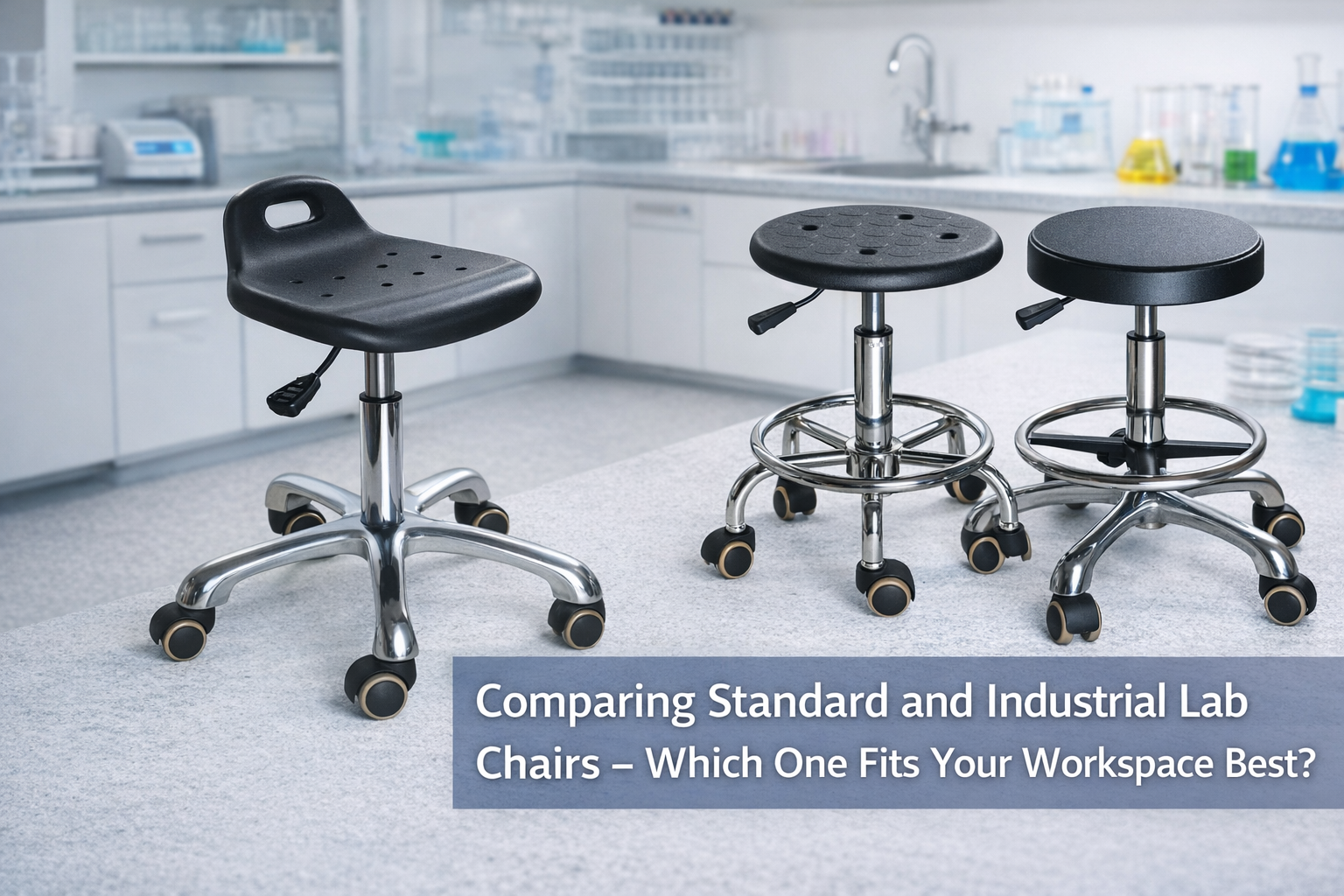
Selecting the right laboratory seating solution is essential for both comfort and performance. Although standard lab chairs and industrial lab chairs share a common goal—to support workers in scientific and technical environments—their construction, durability, and functionality differ in key ways. Understanding these distinctions can help organizations make informed choices.
1. Structural Design and Material Strength
Standard lab chairs are typically constructed from light-duty materials such as vinyl or fabric, designed for basic tasks in educational or office-type laboratories. In contrast, the industrial polyurethane with chrome foot ring and casters adjustable laboratory chair features a reinforced polyurethane structure with a chrome base engineered to withstand demanding industrial conditions. This design resists chemicals, moisture, and physical abrasion, making it far more durable.
2. Ergonomics and Adjustability
Comfort and posture support are essential for long working hours. Standard chairs usually include limited height adjustment. However, the industrial polyurethane with chrome foot ring and casters adjustable laboratory chair provides a full ergonomic range—height, tilt, and backrest adjustments—plus a supportive chrome foot ring. These features allow precise positioning to enhance circulation and minimize back strain.
3. Stability and Mobility
Mobility is another critical factor. Standard chairs might use plastic casters or stationary bases. Industrial lab chairs, on the other hand, employ heavy-duty casters combined with a stable metal frame. The industrial polyurethane with chrome foot ring and casters adjustable laboratory chair integrates these qualities, enabling smooth movement between workstations without compromising safety or stability.
4. Hygiene and Maintenance Efficiency
Polyurethane’s non-porous surface is easy to clean and disinfect, a vital feature in industrial and medical labs. Standard materials may absorb contaminants and deteriorate faster under frequent sanitation. Industrial chairs are thus better suited for controlled environments where cleanliness and compliance are mandatory.
5. Cost Efficiency Over Time
Although industrial lab chairs require a larger initial investment, they provide long-term savings due to their resilience and reduced replacement needs. Their chemical resistance and robust build translate to lower maintenance costs and longer service life.
Conclusion: When choosing between standard and industrial lab chairs, consider the intensity of your workspace and the need for durability. For laboratories exposed to chemicals, frequent cleaning, or continuous usage, the industrial polyurethane with chrome foot ring and casters adjustable laboratory chair is the superior option—combining strength, comfort, and reliability for professional performance.
SEO Keywords: polyurethane lab chair, industrial lab seating, ergonomic laboratory chair, medical laboratory chair, ESD safe lab chair, polyurethane stool, chemical resistant chair, adjustable lab stool, ergonomic polyurethane seating, chrome foot ring lab chair, caster base lab stool, cleanroom seating solution, laboratory task chair, industrial adjustable chair, ergonomic seating for lab workers, height-adjustable lab stool, PU laboratory chair supplier, scientific workspace seating, heavy-duty lab chair, laboratory furniture manufacturer, polyurethane seating system, antimicrobial chair surface, industrial seating with casters, lab technician chair, cleanroom polyurethane stool, healthcare lab seating, safety certified lab chair, ergonomic PU industrial chair, chrome ring adjustable stool, chemical resistant lab furniture, biomedical laboratory chair, durable polyurethane seating, stool with adjustable backrest, lab-grade seating system, mobile laboratory stool, antistatic polyurethane chair, laboratory chair supplier, adjustable height industrial seating, ergonomic workplace furniture, PU seating solution.
READ MORE