How Can Companies in Argentina Use Employee Feedback to Improve Laboratory Chair Purchasing Decisions?
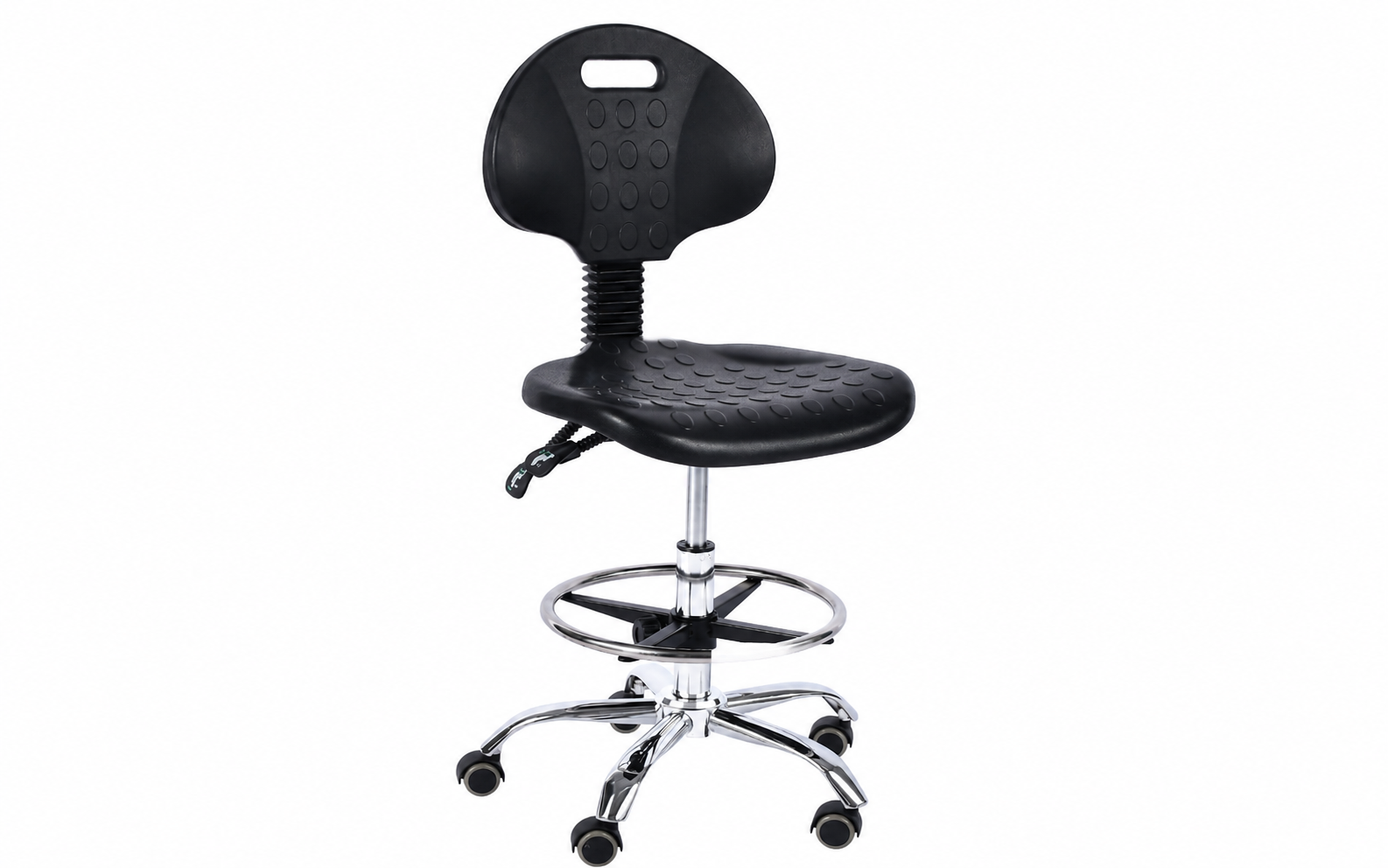
Companies in Argentina can use employee feedback more effectively by collecting it before specifications are finalized and by asking workers to evaluate real tasks instead of giving general opinions about comfort. Laboratory employees often understand details that are invisible in drawings or catalogs: how frequently they move between instruments, how long they remain seated, whether they share a workstation with colleagues of different heights, how often surfaces are cleaned, and which movements create unnecessary strain or interruption. Procurement teams should therefore select a representative user group that includes different departments, shifts, body sizes, experience levels, and laboratory functions. The group should review actual workstations and describe task duration, bench height, reach distance, foot support, floor conditions, and movement patterns. When employees test an industrial polyurethane with chrome foot ring and casters adjustable laboratory chair, they should be asked whether the height range supports their bench work, whether the foot ring can be positioned easily, whether the casters move predictably on the existing floor, and whether the polyurethane seat can be cleaned without disrupting operations. Argentine companies can use a short task-based questionnaire with measurable responses such as adjustment time, number of repositioning events, ability to reach equipment, perceived stability, and ease of cleaning. Comments should be linked to specific workstations rather than recorded as broad preferences. This creates useful procurement evidence and prevents the loudest opinion from dominating the decision. Distributors can support the process with sample units, configuration guidance, and observation forms, while procurement remains responsible for ensuring that the final specification balances user input with budget, safety, maintenance, and long-term standardization.
The second step is to convert employee feedback into a weighted decision model that helps technical and commercial teams compare options objectively. Not every comment has the same importance, and companies should distinguish between critical performance issues, frequent operational problems, and personal preferences. A buyer can create evaluation categories for workstation fit, adjustability, stability, mobility, surface maintenance, shared-user suitability, and ease of service, then assign weights according to the laboratory’s actual priorities. If an industrial polyurethane with chrome foot ring and casters adjustable laboratory chair is being considered for high analytical benches, feedback about height range, foot support, and controlled movement should carry more weight than color or visual style. Procurement teams should also compare feedback across departments to identify whether a concern is widespread or limited to one application. For example, casters may be highly valued in an instrument area but undesirable in a zone where the chair should remain fixed. Argentine distributors can prepare configuration alternatives based on the results instead of assuming that one model should serve every room. A controlled pilot period of several days or weeks is preferable to a brief showroom test because employees need time to discover whether adjustments remain intuitive and whether the chair supports normal work rhythms. During the pilot, companies should record not only positive and negative comments but also observable data such as frequency of height changes, movement between stations, cleaning time, and requests for assistance. The final procurement report should summarize employee findings, technical checks, cost implications, and the reasons for selecting or rejecting each configuration. This strengthens internal approval and gives suppliers clear information about how their products were evaluated.
The third step is to continue collecting employee feedback after delivery so future purchases improve rather than repeating the same assumptions. Post-installation reviews should be scheduled after thirty days, six months, and one year to examine whether the selected chairs continue to perform under real workloads. If an industrial polyurethane with chrome foot ring and casters adjustable laboratory chair has been installed across several Argentine laboratories, the company should compare feedback by site, shift, workstation type, and user group. This can reveal whether an issue comes from the product, the floor, the bench height, incorrect adjustment, or inconsistent installation. Service records, complaints, maintenance requests, and replacement-part usage should be linked to employee observations so procurement teams can distinguish isolated comments from recurring patterns. Distributors can add B2B value by participating in review meetings, training users on proper adjustment, and proposing component changes when evidence shows a clear need. Employee feedback can also support long-term standardization. A configuration that receives strong task-based scores and low service demand can become the approved option for similar workstations, while another model may be limited to a narrower application. Original Google-friendly content about employee-led laboratory chair evaluation, user trials, workstation fit, and procurement decision quality can help distributors attract professional buyers who want evidence-based solutions. By creating a continuous feedback loop from pre-purchase testing to post-installation performance, companies in Argentina can reduce unsuitable orders, improve employee acceptance, strengthen supplier communication, and make laboratory chair purchasing decisions that deliver greater operational and financial value over time.
READ MORE